Green-Eyed and In Love: The Surprising Truth About Jealousy in Healthy Relationships
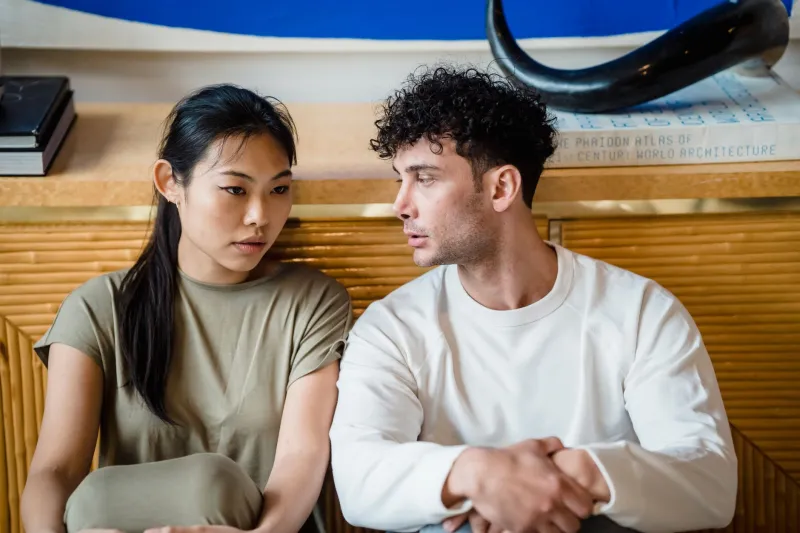
We've all been there. Your partner laughs a little too long at someone else's joke, or you spot a text notification from a name you don't recognize, and suddenly your stomach drops. That familiar, uncomfortable twist — jealousy — shows up uninvited and refuses to leave quietly.
For most of us, feeling jealous triggers immediate guilt. Am I being controlling? Am I insecure? Is this a red flag about ME? We've been told so many times that jealousy is toxic that we've started treating even the mildest flicker of it like a five-alarm fire.
But here's the thing: the science, the relationship experts, and honestly, a lot of real couples — they tell a more nuanced story. Jealousy isn't inherently the villain. It's more like a smoke detector. Sometimes it's warning you about an actual fire. Other times, it's just going off because someone burned toast.
Let's dig into what jealousy is actually telling you, when it works for your relationship, and — crucially — when it starts tearing everything down.
What Jealousy Is Really Saying
At its core, jealousy is an emotional response to a perceived threat to something you value. In a romantic context, that "something" is your partner and the relationship you've built together. Relationship psychologist Dr. Robert Leahy, author of The Jealousy Cure, has described mild jealousy as a natural byproduct of genuine attachment — it signals that you care deeply about what you have.
Think about it this way: if you felt absolutely nothing when someone flirted with your partner at a party, would that actually be a good sign? For most people, a complete absence of any protective instinct can feel more unsettling than reassuring. A small, manageable spark of jealousy can remind both partners that the relationship has real emotional weight.
In evolutionary terms, humans developed jealousy as a bonding mechanism. It motivated our ancestors to protect their partnerships and signal commitment. Fast-forward to today, and that same wiring still shows up — just in the context of Instagram DMs instead of rival cave dwellers.
When Jealousy Actually Helps
Couple therapists often describe what they call "functional jealousy" — the kind that surfaces briefly, gets communicated openly, and ultimately brings partners closer together.
Take Marcus and Jenna, a couple from Austin who've been together for six years. Jenna admits she felt a sharp pang of jealousy when Marcus started a new job with a close-knit team that went out for drinks every Friday. "I didn't freak out or accuse him of anything," she says. "But I did tell him, 'Hey, I miss you on Fridays and I'd love if we could make Saturday mornings our thing.' He loved that I said something. It actually opened up a whole conversation about how we'd been drifting a little."
That's functional jealousy doing its job. It surfaced a real emotional need, got communicated without blame, and strengthened the couple's connection instead of eroding it.
Mild jealousy can also serve as an attraction booster. Research published in Evolutionary Psychology found that when partners occasionally demonstrate that they're desirable to others, it can reignite interest and appreciation within the relationship. There's a reason the phrase "someone else noticing what you have" is such a common experience — it can make you fall a little more in love with your person all over again.
The Line Between Spark and Scorched Earth
Here's where things get complicated — and where a lot of couples lose their footing.
Healthy jealousy is fleeting, self-aware, and leads to communication. Toxic jealousy is persistent, accusatory, and leads to control. The emotional experience might feel similar in the moment, but the behaviors that follow are completely different.
Some red flags that jealousy has crossed into dangerous territory:
Surveillance and monitoring. Checking your partner's phone without permission, tracking their location, or demanding access to their social media accounts aren't protective behaviors — they're violations of trust and autonomy.
Accusations without evidence. When jealousy becomes a pattern of assuming the worst regardless of what your partner actually does, it stops being about protecting the relationship and starts being about punishing your partner for your own anxiety.
Isolation tactics. If one partner's jealousy leads them to discourage or outright forbid friendships, especially with people of a particular gender, that's a significant warning sign. Healthy love expands your world — it doesn't shrink it.
Emotional punishment. Giving the silent treatment, picking fights, or withdrawing affection every time your partner interacts with someone you perceive as a threat is a form of emotional manipulation, even if it doesn't feel that way in the moment.
Relationship coach and author Terri Cole often points out that toxic jealousy is rarely actually about the other person. "It's almost always rooted in unresolved personal fear," she's said in interviews. "Fear of abandonment, fear of not being enough. The partner becomes a target for something that really needs to be addressed internally."
A Framework for Checking In With Yourself
So how do you actually figure out which kind of jealousy you're dealing with — especially when you're in the middle of feeling it? Try running through these three questions:
1. Is this based on behavior or just possibility? If your jealousy is triggered by something your partner actually did — flirting, being secretive, breaking a boundary you'd both agreed to — that's worth discussing. If it's triggered purely by imagined scenarios or your partner simply existing near other people, that's a signal to look inward.
2. What do I want to do with this feeling? If your instinct is to talk to your partner calmly and express a need, you're in healthy territory. If your instinct is to snoop, interrogate, or punish, pump the brakes.
3. Is this a pattern or a moment? Everyone gets a little jealous sometimes. If it's occasional and manageable, it's probably just part of being human. If it's constant and consuming, it may be worth exploring with a therapist — not because you're broken, but because you deserve to feel secure.
Turning the Feeling Into Fuel
The couples who navigate jealousy best aren't the ones who never feel it. They're the ones who've built enough trust and communication skills to actually use it productively.
When a moment of jealousy surfaces, try treating it as a conversation starter rather than a crisis. Something as simple as "Hey, I felt a little off tonight and I think it's because I've been missing you" can transform a potentially destructive emotion into a moment of genuine intimacy.
Jealousy, at its root, is just love with its guard up. The goal isn't to eliminate it — it's to make sure it's working for your relationship instead of against it.
And if you ever find yourself unsure which side of the line you're on? That self-awareness alone is already a really good sign.